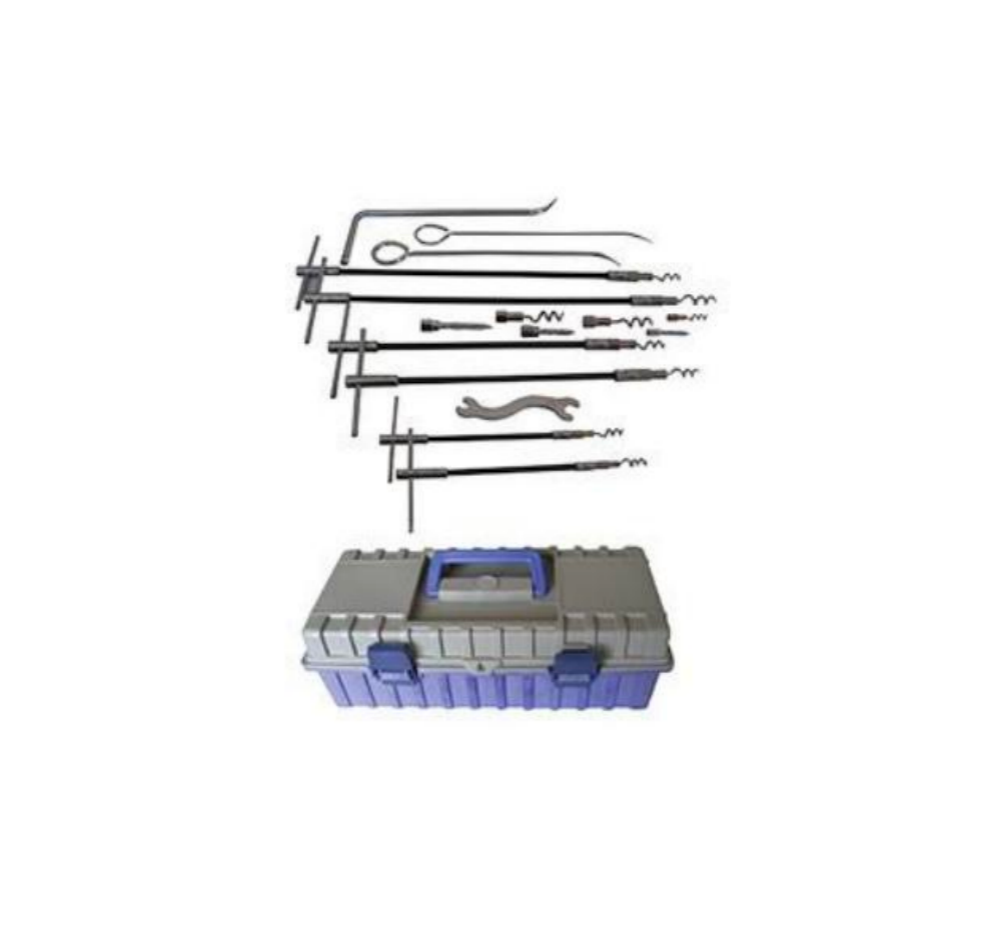
HY9400 Filling Tool
Packing Removal and Installation Tool
Seal packing is a wear-prone component in mechanical systems. Its service life depends heavily on the installation method. To replace it, follow these steps:
1. Before installing new packing, remove all used packing rings using the appropriate tool and thoroughly clean the stuffing box. Inspect all internal surfaces for wear, eccentricity, or other defects. If any issues are found, repair or replace the affected parts as necessary.
2. Place the selected filler on a clean cutting board or paper to prevent it from adhering to sand or impurities.
3. Before assembly, the packing must be molded using a die. To do this, cut the packing material at an angle of 45° or 90° with a sharp knife. Insert the cut packing into a die that matches the dimensions of the packing chamber (for easier assembly, the die's inner and outer diameters should be larger and smaller than the chamber by 0.2 mm, respectively). Place it on a press and compact it into a ring shape under a pressure of 300–500kgf/cm2.
4. Install the pre-compressed ring-shaped packing into the stuffing box one by one, with a layer of grease applied to each ring's surface. For each ring, offset the cut ends by 120 degrees from the previous ring. Use a wooden sleeve to guide the packing rings into the bottom of the stuffing box, ensuring they are firmly and evenly compressed.
5. For reciprocating machinery, guide rings should be installed at both ends and in the middle of the stuffing box to support the plunger's weight and maintain its concentric motion.
6. To improve sealing performance, use a combination of two or more types of packing or gaskets.
7. After installing the packing rings, fit the gland and gradually compress the packing by tightening the gland bolts.
8. Before starting operation, run the equipment under no-load conditions to ensure there are no abnormalities before proceeding with full operation. After startup, carefully monitor for excessive leakage due to insufficient compression or dangerous overheating and packing damage caused by over-tightening and rapid friction heat generation.
9. After load testing, continuously monitor and maintain the equipment carefully. Ensure the cooling and lubrication systems operate normally. If leakage is severe, tighten the packing gland, but avoid over-tightening in a single step.